
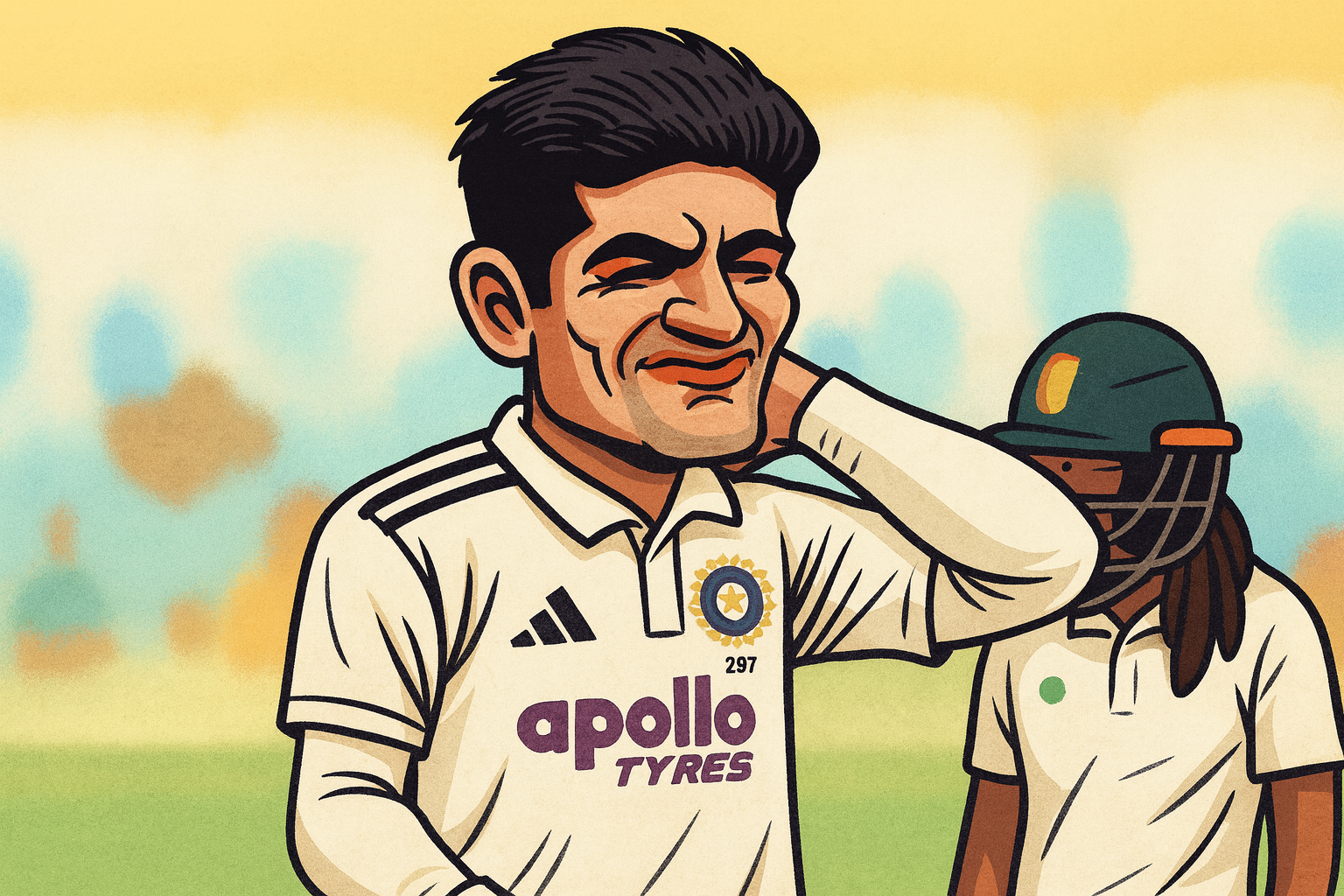
There are cricketers who arrive quietly, slipping into the game like a whisper. There are others who burst forth with the force of a monsoon, impossible to ignore. And then there are the rare few who seem to materialise fully formed, as if summoned by the collective imagination of a cricketing nation that has been waiting for them. Shubman Gill belongs to that last category. He did not simply debut. He appeared, radiant and inevitable, a figure who seemed to carry the future in his stride.
From the moment he emerged from the lush cricketing nurseries of Punjab, Gill was spoken of in reverent tones. His batting was described as classical, elegant, effortless. His temperament was praised as serene. His technique was hailed as the perfect blend of old world orthodoxy and modern adaptability. He was, in the eyes of many, the next great Indian batsman, the heir to a lineage that stretches from Gavaskar to Tendulkar to Kohli.
Yet with every inheritance comes a burden. And with every prodigy comes a question. For Gill, that question has grown louder with each passing season. It is not a question of talent, for that is beyond dispute. It is a question of transformation. Can a prodigy become a giant? Can promise become inevitability? Can elegance become dominance? Can a young man carrying the hopes of a billion people find his own path through the labyrinth of expectation?
This is the Shubman Gill question. And it is far more complex than it first appears.
The Birth of a Prodigy
To understand the weight that rests on Gill’s shoulders, one must return to the beginning, to the fields of Fazilka and the training grounds of Mohali, where a young boy with a bat seemed to move through the world with a kind of preordained grace. His father, Lakhwinder Singh, recognised the spark early. He built a pitch on their farm, bowled to him for hours, and nurtured a dream that soon became a shared obsession.
Gill’s rise through the junior ranks was not merely impressive, it was emphatic. He dominated age group cricket with a calm authority that belied his years. His strokes were not the wild flourishes of a precocious child but the measured, precise movements of someone who understood the geometry of batting. Coaches spoke of his balance, his stillness, his ability to play late. Teammates spoke of his hunger, his discipline, his quiet confidence.
The 2018 Under 19 World Cup was his coronation. As India’s vice captain and batting fulcrum, he produced innings of such composure that seasoned observers found themselves searching for comparisons. Was he the next Kohli? The next Dravid? The next Tendulkar? Or was he something else entirely, a new archetype for a new era?
By the time he lifted the trophy, the narrative had already taken shape. Shubman Gill was not just a talent. He was a destiny.
The Debut That Announced a Future
When Gill finally made his Test debut in December 2020, it felt less like an introduction and more like a long awaited unveiling. The stage was the Boxing Day Test at the Melbourne Cricket Ground, a cathedral of cricket where careers are forged in the furnace of expectation. India were reeling from the humiliation of Adelaide, where they had been bowled out for 36. The team was wounded, the nation anxious, the series hanging by a thread.
Into this cauldron walked a 21 year old with a serene expression and a bat that seemed to hum with possibility. His first innings was a study in composure. He left well, drove beautifully, and played with a clarity that suggested he belonged. His 45 was more than a score. It was a statement. His 35 in the second innings was equally assured. India won the Test, and with it, the momentum that would carry them to one of the greatest series victories in their history.
But it was in Brisbane, at the Gabba, that Gill truly announced himself. Chasing 328 on a pitch that still held menace, he played an innings of breathtaking audacity. His 91 was a blend of elegance and aggression, a declaration that he was not merely a caretaker of the innings but a protagonist. He hooked Pat Cummins with disdain, drove Josh Hazlewood with authority, and carried India to the brink of a historic triumph.
In that moment, the question was not whether Gill would succeed. It was how soon he would ascend to the pantheon.
The Weight of Inheritance
Yet cricket, like life, rarely follows a straight line. The path from prodigy to great is not a gentle ascent but a jagged climb, filled with detours, doubts, and moments of reckoning. For Gill, the burden of inheritance has been both a blessing and a curse.
India is a nation that does not merely watch cricket. It breathes it. It dreams it. It invests in its heroes with a fervour that borders on the spiritual. To be anointed as the next great Indian batsman is to inherit not only a legacy but a responsibility. It is to carry the expectations of millions who see in you the continuation of a story that has shaped their lives.
Gill’s technique, so often praised for its purity, has at times become a source of scrutiny. His off stump awareness has been questioned. His tendency to play away from the body has been dissected. His struggles in certain conditions have been magnified. Every failure has been framed not as a momentary lapse but as a potential flaw in the prophecy.
The comparisons, once flattering, have become suffocating. To be the next Kohli is to chase a shadow. To be the next Tendulkar is to chase a myth. To be the next Dravid is to chase a monument. And yet, the public imagination insists on these parallels, as if greatness must always be inherited rather than forged anew.
Gill, for all his talent, is still a young man navigating the complexities of identity, expectation, and evolution. And that journey is far from simple.
The T20 Transformation and the Question of Identity
One of the most intriguing aspects of Gill’s career has been his transformation in T20 cricket. For a player once seen as a classical red ball specialist, his rise as a dominant force in the Indian Premier League has been nothing short of remarkable. His 2023 season with the Gujarat Titans was a revelation. He scored runs with a fluency that bordered on the poetic, blending timing with power, elegance with ruthlessness.
Yet this transformation has raised new questions. Has Gill become too enamoured with the white ball? Has the aggression required in T20 cricket seeped into his Test game? Has the pursuit of strike rates compromised the patience that once defined him?
These questions are not merely technical. They are existential. They speak to the broader tension within modern cricket, where players must constantly shift between formats, mindsets, and expectations. For Gill, the challenge is not simply to adapt but to integrate, to find a unified identity that can withstand the demands of a game that is evolving faster than ever before.
There is also the question of role. In T20 cricket, Gill has embraced the mantle of aggressor, of match winner, of the player who dictates terms. In Test cricket, he has oscillated between roles, sometimes anchor, sometimes aggressor, sometimes something in between. The lack of clarity has at times been visible in his shot selection, his tempo, his decision making.
The Shubman Gill question, therefore, is not only about talent. It is about identity. Who is he as a batsman? Who does he want to be? And who does Indian cricket need him to be?
The Psychological Landscape of Expectation
To understand Gill’s journey, one must look beyond technique and statistics. One must enter the psychological landscape of a young man carrying the hopes of a nation. The pressure on Indian cricketers is unlike anything else in sport. Every innings is a referendum. Every failure is a crisis. Every success is a prophecy fulfilled.
For Gill, the scrutiny has been relentless. His body language is analysed. His expressions are interpreted. His form is debated with an intensity that borders on obsession. Social media amplifies every moment, turning minor dips into narratives of decline.
And yet, through it all, Gill has maintained a remarkable composure. He speaks softly, carries himself with dignity, and rarely betrays emotion. But beneath that calm exterior lies the reality of a young athlete navigating a world that demands perfection.
The burden of inheritance is not simply the expectation to succeed. It is the expectation to succeed in a particular way. Gill is expected to be elegant, to be dominant, to be consistent, to be the face of a new generation. He is expected to carry forward the legacy of Indian batting while also forging a new path.
This is a heavy load for anyone, let alone someone still in the early chapters of his career.
The Technical Puzzle and the Road Ahead
From a purely technical perspective, Gill’s game remains a fascinating study. His strengths are undeniable. His balance is exquisite. His timing is sublime. His ability to play both pace and spin with equal assurance is rare. His cover drive is a work of art. His back foot play is crisp and authoritative.
Yet there are areas that require refinement. His off stump judgment, particularly in seaming conditions, has been exposed at times. His tendency to play away from the body has led to dismissals that feel avoidable. His footwork against high quality spin, while generally solid, occasionally lacks the decisiveness that separates the good from the great.
These are not flaws. They are growing pains. Every great batsman has faced them. Tendulkar had to conquer the short ball. Dravid had to overcome early doubts about his strike rate. Kohli had to master the fourth stump line. Gill’s challenges are part of the natural evolution of a player who is still learning, still adapting, still discovering the full extent of his abilities.
The question is not whether he can overcome these challenges. The question is how he will respond to them. Will he refine his technique with the patience of a craftsman? Will he embrace the grind of Test cricket with the same enthusiasm he brings to the IPL? Will he find the balance between aggression and restraint that defines the greats?
These are questions that only time can answer.
The Burden and the Beauty of Potential
There is a particular kind of beauty in watching a prodigy grow. It is the beauty of possibility, of potential, of the unknown. With Gill, that beauty is magnified by the elegance of his batting, the serenity of his presence, the promise of what he might become.
But potential is also a burden. It is a shadow that follows a player, whispering of what could be, reminding him of the expectations that surround him. For Gill, the burden is immense. He is not merely expected to succeed. He is expected to lead a generation, to carry a legacy, to become the face of Indian cricket in a world that demands constant reinvention.
And yet, there is something in Gill’s demeanor that suggests he is built for this. He does not seem overwhelmed by the spotlight. He does not seem rattled by failure. He does not seem intoxicated by success. He moves through the game with a quiet confidence, a sense of purpose, a belief that his journey is unfolding exactly as it should.
Perhaps that is the true mark of greatness. Not the absence of struggle, but the ability to navigate it with grace.
The Shubman Gill Question
So what, ultimately, is the Shubman Gill question? It is not a question of talent. That is beyond doubt. It is not a question of potential. That is abundant. It is not even a question of form, for form is transient.
The Shubman Gill question is a question of transformation. Can a prodigy become a pillar? Can elegance become authority? Can promise become legacy? Can a young man carrying the weight of inheritance carve out a destiny that is uniquely his own?
It is a question that will not be answered in a single innings, a single series, or even a single year. It is a question that will unfold over time, through triumphs and failures, through reinvention and resilience.
And perhaps that is what makes Gill’s journey so compelling. It is not a story of inevitability. It is a story of becoming.
A Future Still Unwritten
As Gill stands at the crossroads of his career, the possibilities are endless. He could become the next great Indian batsman, a figure who defines an era. He could become a multi format titan, equally dominant in whites and coloured clothing. He could become a leader, a statesman, a symbol of modern Indian cricket.
Or he could become something entirely different, something we cannot yet imagine.
What is certain is that his journey will be watched with fascination, with hope, with expectation. For in Shubman Gill, India sees not only a cricketer but a reflection of its own aspirations, its own evolution, its own belief in the power of talent nurtured with care.
The Shubman Gill question remains unanswered. And that, perhaps, is the most exciting thing of all.



Leave a Reply