
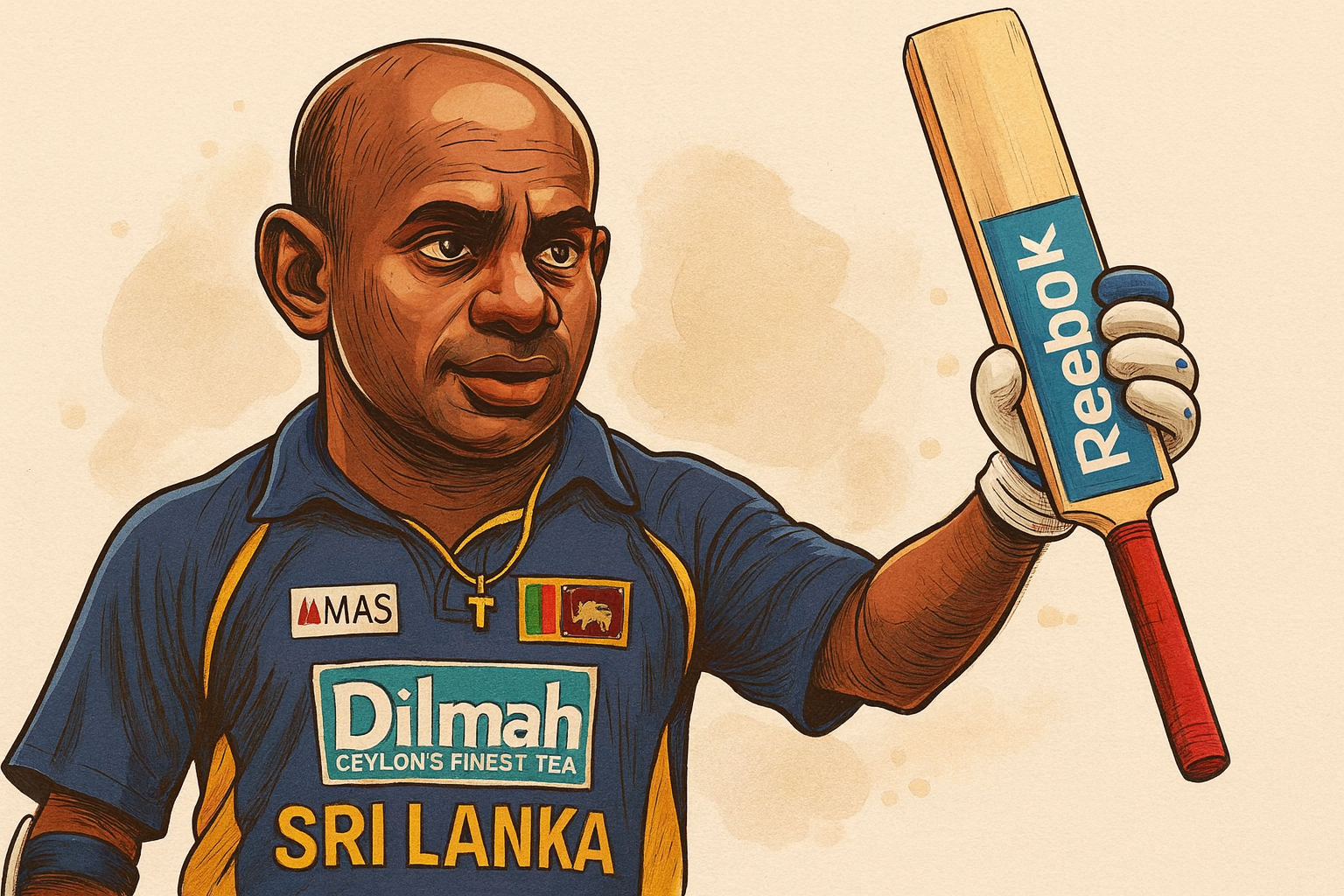
Before Sanath Jayasuriya arrived, Sri Lankan cricket lived in a strange emotional space, admired for its artistry, respected for its grit, but rarely feared. The team had charm, yes, and a handful of world‑class players, but there was a lingering sense of smallness, a quiet acceptance of hierarchy. The giants of the game, Australia, Pakistan, India, West Indies, cast long shadows, and Sri Lanka often played within them. The island had talent, but not yet the audacity to believe it could bend the world to its will.
Then came Jayasuriya, a broad‑shouldered left‑hander from Matara, carrying with him a kind of raw, untamed energy that felt almost mythic. He didn’t walk to the crease so much as stride into a fight. There was something volcanic about him, a sense that he could erupt at any moment, that he carried fire in his wrists and thunder in his swing. He wasn’t polished. He wasn’t elegant in the classical sense. But he was alive in a way cricket had rarely seen.
For a nation wrestling with its own identity, its own fractures and uncertainties, Jayasuriya became a kind of emotional accelerant. He represented possibility, the idea that Sri Lanka didn’t have to be polite or deferential or grateful for scraps. He played with a freedom that felt contagious. When he hit the ball, it wasn’t just a boundary, it was a declaration. The crack of his bat echoed like a new national heartbeat.
He made Sri Lankans feel taller, louder, braver.
And that was the beginning of everything.
Jayasuriya didn’t just change matches. He changed the mood of a country. He gave Sri Lanka permission to dream in colour, to imagine itself not as a footnote in cricket’s story but as a force capable of rewriting the script entirely. His rise wasn’t just sporting evolution, it was cultural ignition.
He was the spark… and once he lit the fuse, nothing was ever the same.
The 1996 Revolution: When Fear Became a Weapon
The 1996 World Cup is remembered as Sri Lanka’s miracle, but miracles do not happen by accident. They happen when someone decides to break the rules so completely that the world has no choice but to follow.
Jayasuriya was that someone.
In an era when the first 15 overs were treated with caution, a time to survive, to settle, to respect the bowlers, he walked out with a different philosophy entirely: why survive when you can terrify? Alongside Romesh Kaluwitharana, he turned the opening overs into a battlefield. Field restrictions became invitations. Fast bowlers became targets. Tradition became rubble.
The assault on India in Delhi remains one of the most shocking passages of play in World Cup history. Jayasuriya didn’t just hit boundaries, he detonated them. He carved through the Indian attack with a kind of joyful violence, as if he were rewriting the geometry of the game in real time. Then came England in Faisalabad, another demolition, another statement, another reminder that Sri Lanka had stopped asking for respect and started taking it.
For Sri Lankans watching at home, it felt like rebellion… like catharsis… like a small island nation standing up to the giants and saying, we are not afraid of you anymore.
Jayasuriya’s aggression wasn’t just tactical. It was emotional. It was symbolic. It was liberation.
And the world felt it. Teams scrambled to adapt. Coaches rewrote playbooks. Analysts searched for explanations. But the truth was simple: Jayasuriya had changed the psychology of ODI cricket. He had weaponised fear. He had shown that the opening overs could be a place of dominance, not survival.
When Sri Lanka lifted the trophy, it wasn’t just a victory. It was a revolution. And at the centre of that revolution stood a man who had turned audacity into destiny.
Beyond the Blaze: Reinvention, Longevity, and the Quiet Grind
It would have been easy, expected even, for Jayasuriya to remain a one‑dimensional destroyer, a man defined by a single era of explosive batting. But he refused to be a caricature. He refused to be predictable. And so he reinvented himself, again and again, in ways that revealed the depth beneath the blaze.
As the years passed, he became a complete all‑rounder. His left‑arm spin, once considered part‑time, evolved into a genuine weapon. He bowled with guile, with patience, with a sense of rhythm that belied his reputation as a hitter. He broke partnerships. He controlled middle overs. He became the kind of bowler captains trusted when the game tightened.
Then came his Test renaissance, a chapter many forget, but one that speaks volumes about his character. Opening in the longest format, he produced innings of immense discipline and endurance. His 340 against India in 1997 was not a slogger’s knock, it was a marathon, a masterpiece of concentration and adaptability. It proved that beneath the firestorm lay a craftsman.
And then there was his longevity. While others faded, Jayasuriya kept finding new ways to matter. Into his late 30s, he was still producing match‑winning performances. Still sprinting between the wickets. Still throwing himself around the field. Still hitting balls into the stratosphere.
There was something deeply human about this phase of his career, the ageing warrior refusing to surrender, refusing to let the world move on without acknowledging that he still had something left to give. It wasn’t glamorous. It wasn’t always pretty. But it was gritty, stubborn, and profoundly admirable.
This was Jayasuriya beyond the myth, the grinder, the learner, the survivor… the man who kept evolving because he loved the game too much to let it pass him by.
A Legacy Written in Fire and Freedom
Jayasuriya’s impact on Sri Lankan cricket is not measured in runs or wickets alone. It is measured in attitude, in identity, in the way an entire generation learned to see itself.
He changed the DNA of Sri Lankan cricket. Before him, aggression was occasional. After him, it became instinct. Fearlessness became the default setting. The idea that Sri Lanka could bully opponents, not just compete with them, became part of the national psyche.
You can see his fingerprints everywhere.
In Tillakaratne Dilshan’s scoops and swagger.
In Kusal Perera’s wild, beautiful chaos.
In Lasith Malinga’s unapologetic individuality.
In every young Sri Lankan who walks to the crease believing that the first ball is not something to survive but something to conquer.
And his influence didn’t stop at the island’s borders. Players like Virender Sehwag, Adam Gilchrist, and Brendon McCullum carried forward the philosophy he pioneered, the idea that opening batsmen could be shock troops, not caretakers. In many ways, Jayasuriya was playing T20 cricket before T20 existed. He anticipated the future by living it.
But perhaps his greatest legacy is symbolic. He proved that greatness can come from unlikely places. That cricket’s beauty lies in its capacity for reinvention. That a player from a small coastal town can change the world if he swings hard enough and believes deeply enough.
His story is not just about cricket… it is about possibility.
The Man Behind the Myth: Memory, Emotion, and Farewell
For all the analysis, all the statistics, all the tactical revolutions, what lingers most about Jayasuriya is the feeling of watching him. The anticipation. The electricity. The sense that anything, absolutely anything, could happen when he took guard.
He was a smiling assassin, a humble destroyer, a man who carried both ferocity and gentleness in the same frame. He was flawed, yes, gloriously human, occasionally inconsistent, sometimes misunderstood, but that only made him more real. More relatable. More beloved.
For a generation of Sri Lankans, his highlights were the soundtrack of childhood. The sixes over point. The cuts that screamed off the bat. The celebrations that felt like communal joy. He wasn’t just a cricketer, he was a memory‑maker.
And when he finally walked away, it felt like the end of an era, not because the game couldn’t move on, but because something irreplaceable had left the stage. A kind of light. A kind of courage. A kind of freedom.
But legends don’t fade. They echo.
Today, when young Sri Lankans pick up a bat and swing with abandon, they are swinging with his spirit. When the national team plays with fire, they are playing with his inheritance. When fans speak of belief, of pride, of daring to dream, they are speaking his language.
Sanath Jayasuriya didn’t just play cricket.
He changed the emotional weather of a nation.
He set Sri Lanka alight… and the glow still hasn’t dimmed.



Leave a Reply