
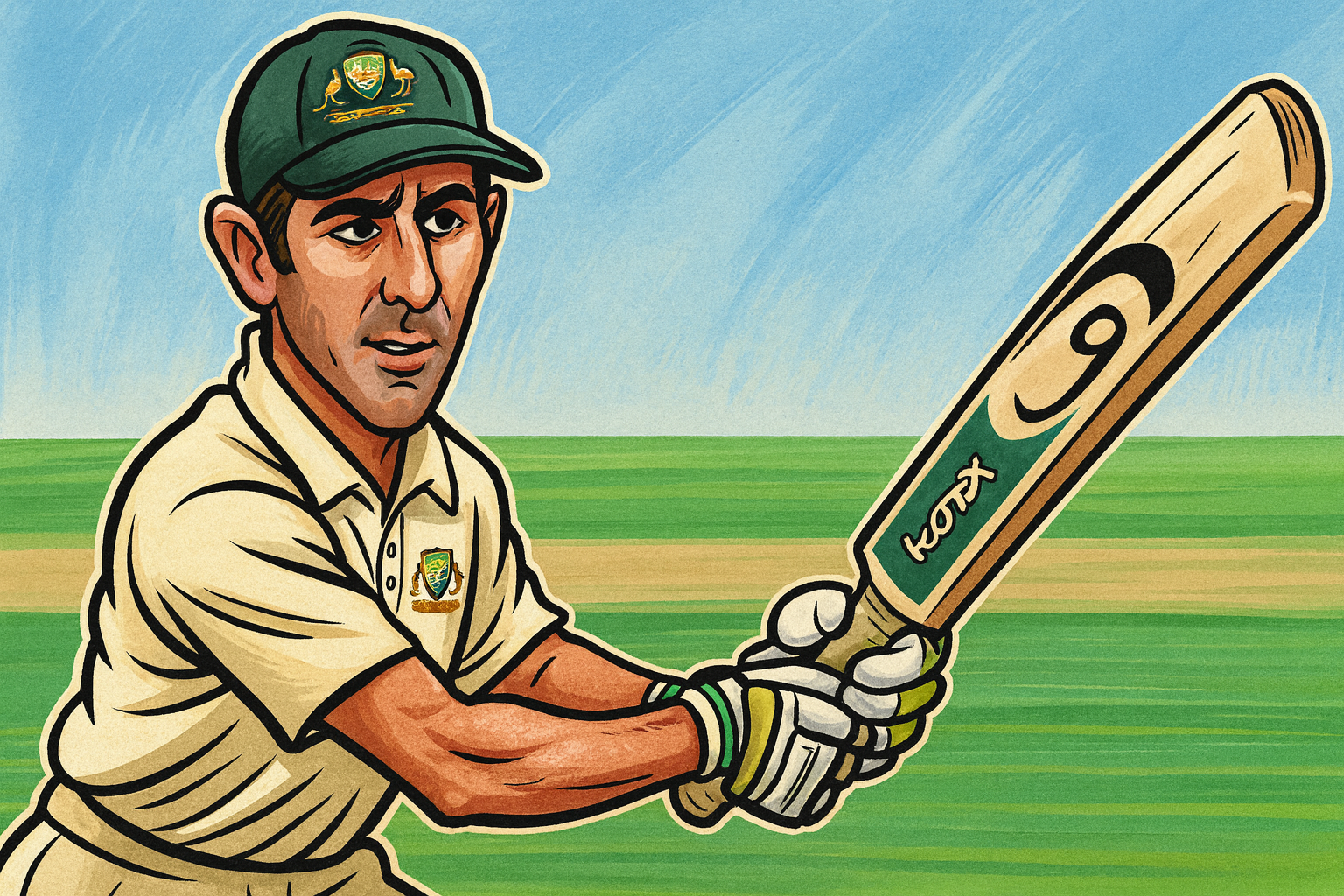
There are moments in sport when time seems to slow, when the noise of competition fades and something far more human takes its place. The news that Damien Martyn, one of Australia’s most gifted and quietly influential cricketers, is in an induced coma after falling ill with meningitis has created one of those moments. At 54, a man whose batting once seemed to defy gravity now lies in a Brisbane hospital, fighting a very different kind of battle. The cricket world has responded with a wave of shock, affection, and hope. Darren Lehmann, Adam Gilchrist, and countless others have spoken publicly of their support, their words carrying the unmistakable tremor of people who suddenly realise how fragile even our heroes can be.
This is not an obituary. It is a pause, a breath taken in the middle of a story we hope is far from over. And in that pause, it feels right to look back at the career of a cricketer whose legacy is richer, subtler, and more enduring than statistics alone can ever capture.
The Prodigy Who Carried a State’s Hopes
Long before he became a mainstay of the Australian middle order, Damien Martyn was a prodigy. Born in Darwin and raised in Western Australia, he debuted in first-class cricket in 1991, a teenager with wrists like silk and a temperament that seemed older than his years. He captained Western Australia for a season and even led Australia A, early signs of the trust placed in him and of the leadership qualities that would later define his presence in dressing rooms across the country.
His Test debut came in 1992, at a time when Australian cricket was beginning its ascent toward the era of dominance that would define the next decade. Martyn was young, elegant, and impossibly gifted. But talent alone is rarely enough to guarantee a smooth rise. His early years were marked by flashes of brilliance and moments of painful scrutiny. The infamous shot he played in the 1994–95 West Indies series, an attempted square drive that led to his dismissal and Australia’s defeat, became a burden he carried for years.
For some players, such moments break them. For Martyn, they forged something deeper.
The Long Road Back, Reinvention and Resilience
When Martyn returned to the Test side in 2000, he was no longer the boy wonder. He was something far more dangerous; a player who had been humbled, hardened, and sharpened by time. The second act of his career is one of the great reinventions in Australian cricket.
From 2000 to 2006, Martyn became the embodiment of composure. His batting was a study in stillness, head steady, hands soft, feet precise. He scored 4406 Test runs at an average of 46.37, with 13 centuries. In ODIs, he added 5346 runs at 40.80, including five centuries. But numbers only tell part of the story.
What made Martyn special was not just how many runs he scored, but how he scored them.
He played spin with a rare, almost subcontinental grace. His cover drive was less a shot than a signature. His back-foot punch could stop time. And when pressure mounted, he seemed to shrink the world around him until only the next ball existed.
His 88* in the 2003 World Cup semifinal, made with a broken finger, remains one of the most courageous innings in Australian cricket history. His Player of the Series performance in the 2004 Border-Gavaskar Trophy, where he top-scored in four of Australia’s eight innings, was a masterclass in technique and temperament.
Martyn did not dominate opponents with brute force. He dismantled them with elegance.
The Artist at the Crease
In an era defined by power, Gilchrist’s explosiveness, Hayden’s intimidation, Ponting’s aggression, Martyn was the counterpoint. He was the poet in a team of warriors.
Teammates often spoke of the sound his bat made, a soft, clean crack that suggested perfect timing rather than raw strength. Commentators described him as one of the game’s great stroke-makers. Fans remember the serenity he brought to the crease, as if the chaos of international cricket simply bent around him.
There was something almost romantic about the way he batted. He did not just score runs; he painted them.
And yet, he was never one to seek the spotlight. Martyn’s genius was quiet, understated. He let others take the headlines while he shaped the innings beneath them. In many ways, he was the heartbeat of Australia’s middle order during its most dominant years.
A Giant of Domestic Cricket
While his international achievements are well known, Martyn’s influence on domestic cricket, particularly in Western Australia, runs just as deep. He was a pillar of the WA side, a captain, a mentor, and a standard-setter. Younger players learned from watching him train, from the way he carried himself, from the way he approached the craft of batting with both reverence and precision.
Western Australia has produced some of the most stylish batters in the country’s history, and Martyn sits comfortably in that lineage. His presence in the dressing room was steadying, his experience invaluable, his example quietly transformative.
The Retirement That Shocked a Nation
In December 2006, just before the third Ashes Test, Martyn announced his immediate retirement from international cricket. The decision stunned fans and teammates alike. Australia was in the middle of reclaiming the Ashes. Martyn had scored a century only weeks earlier. And then, without warning, he walked away.
Some saw mystery in the decision. Others saw clarity. Martyn had always been introspective, always more interested in the art of batting than the theatre of fame. Perhaps he simply knew the moment had come.
His retirement added to the aura that surrounded him, the sense that he was a man who lived by his own rhythm, who refused to be defined by expectation, who valued the integrity of his journey more than the applause at its end.
A Legacy Written in Grace
Today, as he lies in hospital, the cricket world is remembering not just the runs and the trophies, but the feeling of watching Damien Martyn bat. The feeling of witnessing something effortless, something pure.
His legacy is multifaceted:
- A two-time World Cup winner
- One of the finest players of spin Australia has ever produced
- A stylist whose technique influenced a generation
- A teammate whose calmness steadied those around him
- A domestic stalwart who shaped Western Australian cricket
But beyond all that, Martyn represents something rare; the idea that sport can be beautiful. That batting can be art. That elegance can be as devastating as aggression.
The outpouring of support from former teammates, Gilchrist calling him a close friend and expressing hope for his recovery, Lehmann sending love to his family, speaks to the depth of connection he forged across decades in the game.
A Moment of Hope
As fans, we often think of athletes as invincible. They give us memories that feel larger than life, and we forget that they are human, vulnerable, mortal, fragile. The news of Martyn’s illness has reminded us of that truth.
But it has also reminded us of something else; the power of community. The way sport binds people together. The way a single player’s grace can touch millions.
Damien Martyn is in the fight of his life, as one report put it. And the cricket world is fighting with him, in spirit, in memory, in gratitude.
We hope for recovery. We hope for more time. We hope that the man who once made batting look effortless can summon that same quiet resilience now.
Whatever happens, his legacy is secure. It lives in every young batter who tries to time the ball instead of hitting it. It lives in every fan who remembers the way he made them feel. It lives in the soft crack of a perfectly struck cover drive.
And it lives in the hearts of those who watched him turn cricket into something close to poetry.



Leave a Reply